

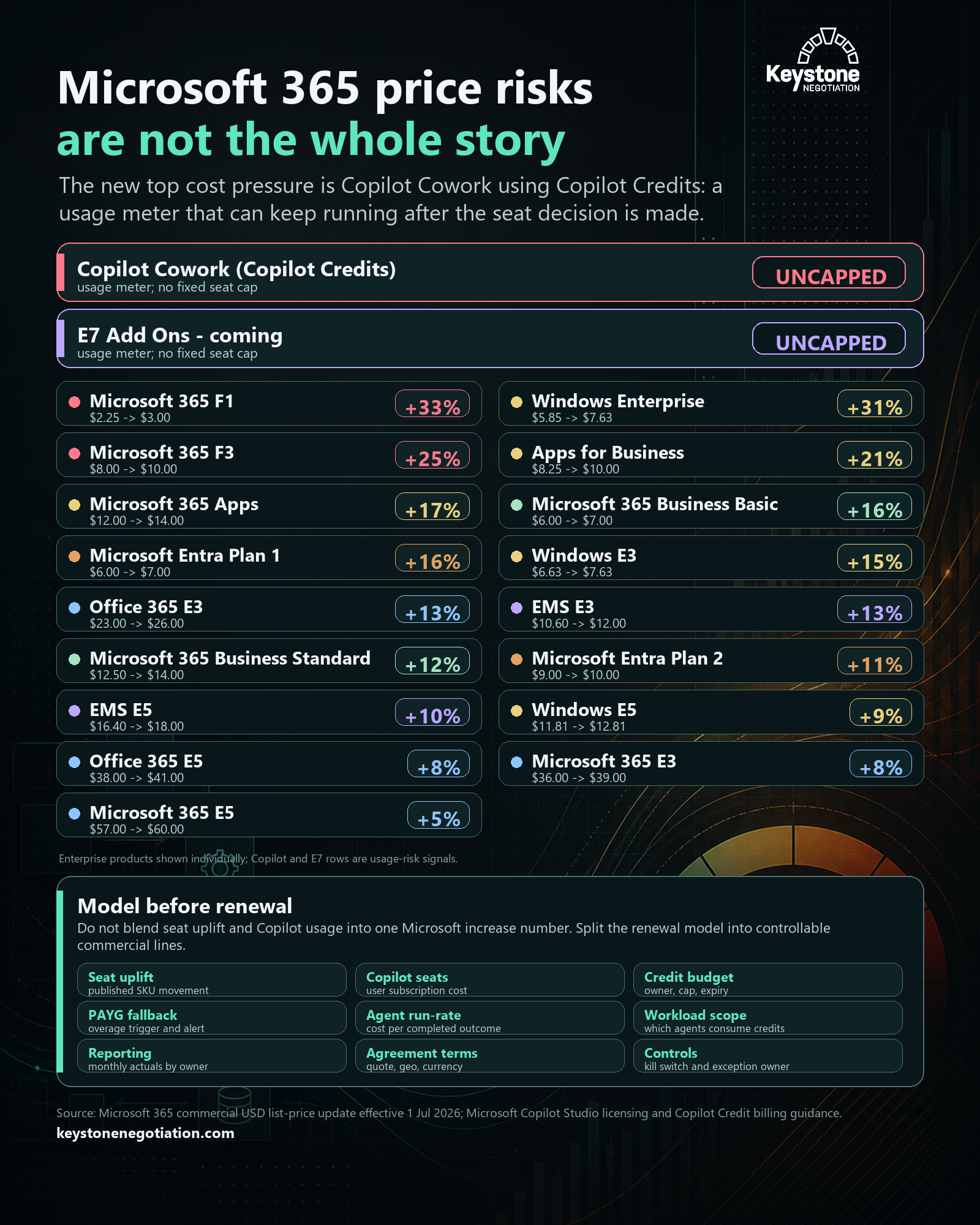
Microsoft 365 price increases are now part of the FY27 renewal conversation. From 1 July 2026, Microsoft commercial list-price changes affected a wide set of Office 365, Microsoft 365, Windows and security SKUs.
The obvious work is to review the published SKU uplifts, renewal date, agreement protection, geography, currency, discount structure and enterprise SKU path. The less obvious work is to model the usage exposure sitting beside the seat estate.
Keystone would put one row at the top of the cost-pressure watchlist:
Copilot Cowork using Copilot Credits - uncapped.
This is not a normal list-price increase. It is a commercial effect created by metered usage.
The published increases are visible
Several published list-price movements are large enough to require immediate attention. Examples include Microsoft 365 F1, Windows Enterprise per device, Microsoft 365 F3, Apps for Business, Microsoft 365 Apps, Office 365 E3 and the Microsoft 365 E3/E5 suite rows.
Those increases matter because they flow directly into renewal modelling. They can affect budget, internal chargeback, business unit allocation, frontline-worker economics and the case for reassessing SKU mix.
But a list-price increase is at least visible. Procurement can see the old price, the new price, the renewal date and the user count. The finance model can calculate the impact.
Copilot Credit usage is different.
Copilot Credits behave like a meter
Microsoft's Copilot Studio licensing guidance explains that Copilot Credits are consumed when agents retrieve information, respond to prompts and perform actions. Microsoft also describes pay-as-you-go billing where customers post-pay based on the actual number of credits consumed in a billing month.
That makes Copilot Cowork and agent adoption a FinOps problem, not just a licensing line item.
The risk is not that Copilot Credits are inherently bad. Usage-based pricing can be efficient when the organisation has strong controls. The risk is adoption without a unit-cost model.
If a business unit creates agents that use grounding, actions, workflows, connectors, retries and exception handling, the monthly cost may grow after the commercial agreement is signed. Prepaid pools, capacity packs and Agent Pre-Purchase commitments can reduce unit price or smooth purchasing, but they do not remove the need to govern demand.
The renewal model needs separate cost lines
A Microsoft 365 renewal model should now separate at least seven cost categories:
- Base licensing uplift
- Enterprise suite movement
- Copilot seat licensing
- Copilot Credit consumption
- Agent and workflow run-rate
- Overage and PAYG fallback
- Support, controls and exception handling
Blending these into a single "Microsoft increase" number hides the actual negotiation levers.
For example, a customer might accept a seat uplift but still need stronger commercial terms around renewal timing, transition protection, consumption governance, prepaid credit expiry, reporting and internal budget ownership.
The practical governance questions
Before scaling Copilot Cowork, Copilot Studio agents or Microsoft 365 Copilot extensions, customers should ask:
- Who owns the Copilot Credit budget?
- Which environments can consume credits?
- What is the monthly cap?
- Who can publish an agent?
- What is the cost per completed business outcome?
- What happens when prepaid credits are exhausted?
- Does usage automatically fall back to pay-as-you-go?
- Which business unit pays for shared agents?
- How are failed runs, retries and exceptions measured?
- What is the kill switch?
These are commercial controls, not only technical controls.
Keystone negotiation view
The FY27 Microsoft 365 renewal should not be framed as a simple percentage increase exercise.
The better frame is:
Seat price plus bundle change plus usage meter plus agreement protection.
That frame gives procurement and technology leaders a cleaner negotiation position. It separates what Microsoft has published from what the customer can still control.
It also prevents the common mistake of treating Copilot and agents as an adoption program while finance later discovers they behave like cloud consumption.
The board will ask how much Microsoft 365 increased. The better question is how much of the new Microsoft operating model is now metered, who owns that meter and what stops it from running without a ceiling.
FAQ
Did every Microsoft 365 product increase on 1 July 2026?
No. Microsoft's published changes vary by SKU. Some products increased materially, some increased more modestly and some were listed as held flat. Customers should validate the exact SKU, geography, currency, agreement motion and renewal timing.
Is Copilot Cowork a normal list-price increase?
No. The Copilot Cowork row in Keystone's image is an analysis row. It represents uncapped usage exposure where Copilot Credits are consumed by agent activity. It should be modelled separately from normal seat price changes.
Are Copilot Credits always uncapped?
Not necessarily. Customers can use purchasing, capacity and governance controls. The commercial risk is that usage can continue through entitlement exhaustion, overage or pay-as-you-go paths if controls are not designed before rollout.
What should customers do before renewal?
Build a renewal model that separates seat uplift, Copilot seats, Copilot Credit consumption, agent run-rate, overage/PAYG exposure and support/control costs. Then align each line to an owner, budget and negotiation position.